
The modern university campus is no longer just a place of books, lectures, and written tests. It has rapidly evolved into an ecosystem driven by data tracking, where digital monitoring systems trace almost every move a student makes. From tracking when you log into the campus learning portal to monitoring your location via smart campus Wi-Fi networks, universities gather massive amounts of information. This trend is part of a larger technological shift known as the Internet of Bodies (IoB), where digital devices monitor, record, and analyze real-time physical and behavioral data directly from human bodies.
When applied to higher education, this data collection creates an intense atmosphere of constant evaluation. Students face immense pressure to keep up with packed schedules, highly complex research papers, and continuous evaluations under watchful digital eyes. This relentless pressure often leads to severe mental exhaustion and cognitive overload. To cope with these overwhelming workloads without letting their grades drop, many undergraduates look for reliable external study aids. Choosing to rely on professional academic writing services has become a common strategy for students who want to balance their academic responsibilities, protect their mental health, and ensure their research meets high institutional standards.
The Reality of Biometric Tracking in Higher Education
Biometric tracking on campus has moved far beyond simple fingerprint scanners used to enter university libraries. Today, colleges are exploring advanced biometric tools to actively measure how students engage with their coursework. These technologies include eye-tracking systems that monitor focus during online lectures, facial analysis software that detects confusion or boredom, and even wearable fitness trackers issued by wellness departments to monitor sleep and heart rate variations during exam weeks.
The main goal behind collecting this physiological data sounds helpful on paper: it aims to catch student burnout early, identify areas where a class is struggling, and provide timely academic interventions. However, turning a student’s body and emotional state into a stream of data points raises major ethical concerns. When an institution starts tracking biological signs of stress, the boundary between helpful guidance and invasive surveillance becomes blurred. It changes the university experience from an open environment of intellectual exploration into a hyper-monitored workspace where students feel judged not just on what they know, but on how their bodies react to stress.
Understanding Cognitive Load and Academic Pressures
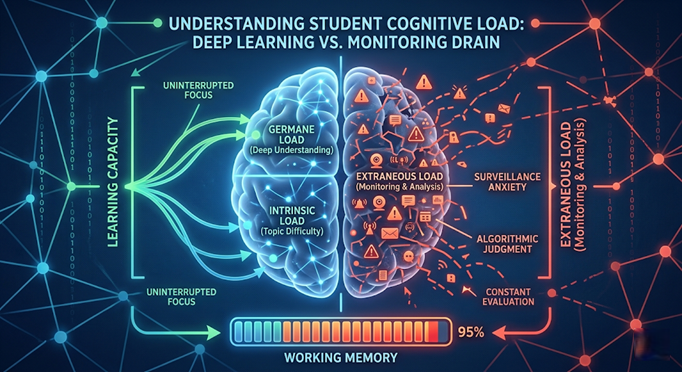
To understand why this monitoring is so stressful, we have to look at the psychological concept of cognitive load. Your brain has a limited amount of processing power at any given time. When you are hit with multiple difficult deadlines, massive reading assignments, and complex laboratory reports all at once, your mental capacity becomes completely overwhelmed.
| Type of Cognitive Load | What It Means in Practice | Impact on College Students |
| Intrinsic Load | The natural difficulty of learning a brand-new topic (e.g., advanced organic chemistry). | Requires deep concentration and quiet, undisturbed study blocks. |
| Extraneous Load | Mental energy wasted on poorly organized instructions or frustrating software interfaces. | Causes unnecessary mental fatigue and distracts from actual learning. |
| Germane Load | The productive mental work used to construct long-term understanding and skills. | This is the ideal state of deep learning that universities should encourage. |
When universities add constant automated tracking to this mix, the extraneous cognitive load skyrockets. Instead of focusing entirely on mastering a difficult subject, a student’s mind is forced to worry about whether they are moving their eyes too much, sitting perfectly still, or showing physiological signs of anxiety that a tracking system might flag.
The Rise of Invasive Algorithmic Proctoring
The most controversial use of biometric tracking happens during remote exams. Automated online proctoring systems use artificial intelligence and webcams to monitor students at home. These tools track micro-expressions, log keystroke patterns, record room audio, and use facial recognition to ensure the person taking the test is actually the enrolled student. If a student looks away from the screen for a few seconds to think, or if a family member walks into the room, the software automatically flags that behavior as “suspicious.”
This algorithmic scrutiny turns online testing environments into spaces of extreme anxiety. For many students, especially those living in shared apartments, crowded homes, or dealing with unstable internet connections, passing these automated identity and environment scans is incredibly difficult. The fear of being falsely accused of cheating by an unfeeling algorithm has made the traditional online testing setup hostile and deeply unfair.
When facing invasive tech environments or overwhelming course requirements, finding an external, trusted expert to do my assignment online serves as a necessary safety net for students to protect their grades and bypass technical biases. By working directly with a dedicated academic support platform at Myassignment Services, students can secure clear, well-structured model papers that help them understand their coursework deeply without the intense anxiety caused by automated tracking tools. This balance helps students protect their personal privacy while ensuring their academic progress remains completely on track.
Ethical Vulnerabilities: Privacy, Bias, and Consent
The rapid adoption of these biometric monitoring tools creates three major ethical vulnerabilities that higher education institutions have failed to fully address:
- Data Security and Ownership: Biometric data is fundamentally different from a standard password. If a university database or a third-party proctoring company suffers a data breach, students cannot simply reset their facial structure or their fingerprint templates. This sensitive biological data remains permanently compromised.
- Systemic Algorithmic Bias: Extensive research shows that facial verification software has significantly higher error rates for students with darker skin tones, individuals who wear thick glasses, and neurodivergent students who may exhibit non-traditional eye movements or physical habits. When a system flags these natural variations as signs of academic dishonesty, it perpetuates deep inequality.
- The Illusion of Informed Consent: While universities claim that students “consent” to using these tracking tools, the reality is that students rarely have a choice. If opting out of a biometric proctoring tool means failing a required course or dropping out of a program, then true, free consent does not exist.
Reclaiming Human-Centered Academic Integrity
True academic integrity cannot be forced through biometric surveillance or continuous physiological tracking. When universities rely on algorithms to police student behavior, they damage the foundational trust between educators and learners. To fix this broken dynamic, higher education must move away from invasive digital monitoring and return to human-centered assessment methods.
This shift involves designing more meaningful assignments, such as open-book applications, interactive oral presentations, and collaborative group projects that test real-world understanding rather than rote memorization under a webcam. At the same time, universities must recognize that severe stress and cognitive overload are not metrics to be quietly tracked on a digital dashboard—they are systemic problems that require real human support, manageable workloads, and compassionate teaching methods.
Frequently Asked Questions (FAQ)
Q.1 What exactly is the Internet of Bodies (IoB) in education?
Ans: The Internet of Bodies (IoB) in an educational context refers to any internet-connected device or software that collects, monitors, and analyzes a student’s biological, biometric, or physical data. This includes facial recognition during online exams, eye-tracking tools on learning apps, and university-issued smartwatches that monitor sleep and stress patterns.
Q.2 How does continuous digital monitoring cause cognitive overload?
Ans: When students know they are being monitored by biometric tools, they are forced to dedicate a portion of their active mental processing power to controlling their physical behavior (such as tracking their eye movements or posture). This leaves less working memory available for complex problem-solving and deep learning, leading to rapid mental exhaustion.
Q.3 Why do automated proctoring systems flag innocent behaviors?
Ans: Automated systems rely on rigid, pre-programmed algorithms to detect cheating. They are designed to flag deviations from a narrow baseline of “normal” behavior. Because of this, common and completely innocent actions—like reading a question out loud, looking at the ceiling to think, adjusting your seating position, or having a door open in the background—are frequently misidentified as cheating.
Q.4 What can universities do instead of using biometric tracking?
Ans: Universities can replace invasive biometric surveillance by focusing on authentic assessment styles. These include project-based assignments, open-resource essays, viva examinations, and continuous practical portfolios. These methods assess a student’s genuine critical thinking and understanding, making automated surveillance entirely unnecessary.
About The Author
Hi, I’m Min Seow. As an academic consultant and research strategist working alongside Myassignment Services, I specialize in helping undergraduate students navigate the increasingly complex intersection of higher education, digital learning technologies, and academic integrity. With a background focused on educational psychology and modern curriculum design, my goal is to break down how advanced campus technologies impact student well-being and performance.